
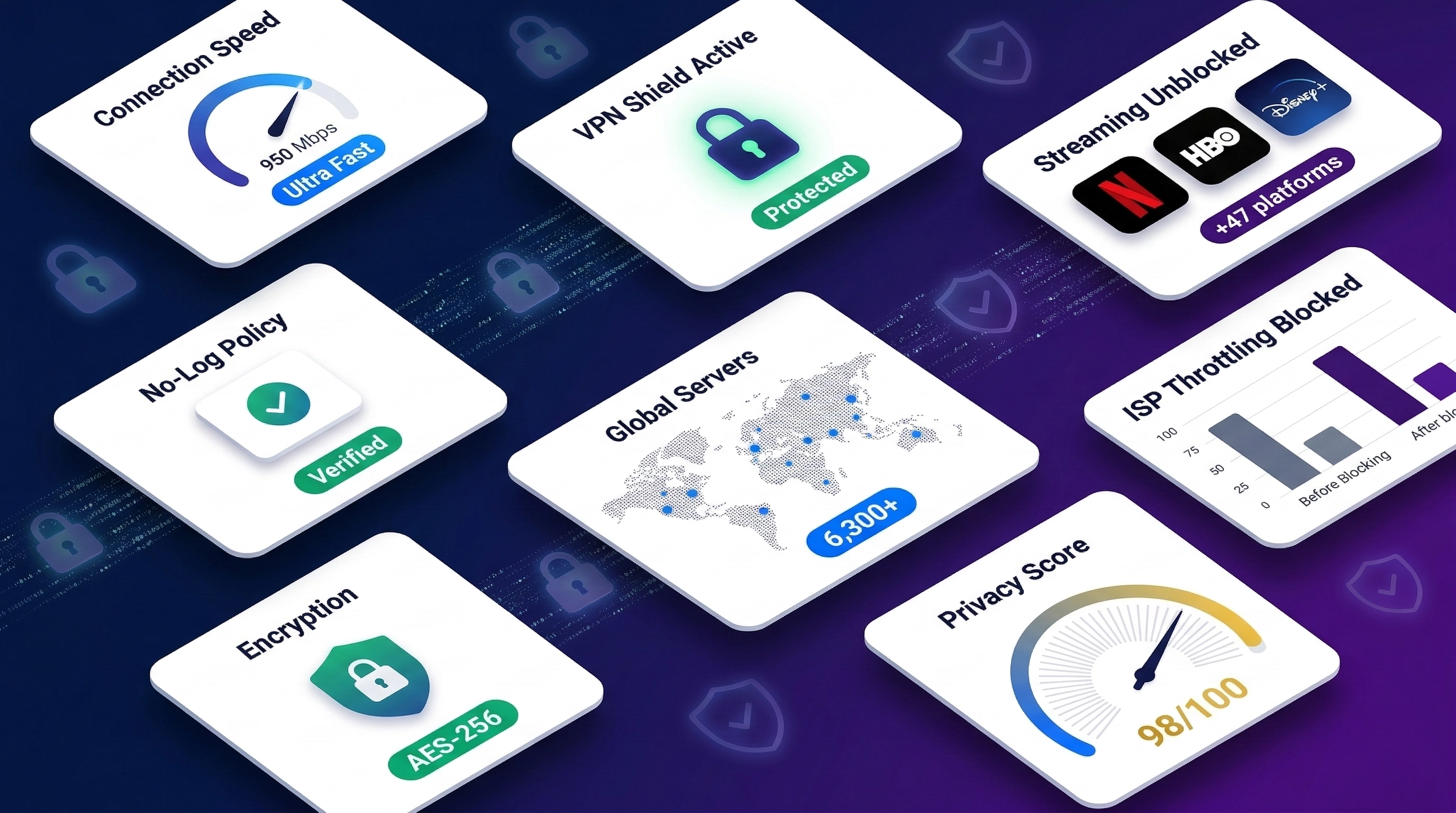
If you're one of the 75 million Americans using a VPN, you've probably noticed things have changed. Streaming services are getting smarter about detecting VPNs, ISPs are throttling bandwidth more aggressively, and the whole digital surveillance situation isn't exactly getting better.
I spent the last few weeks testing the top VPN providers to see which ones can actually handle modern demands—whether that's streaming in 4K, keeping your gaming ping low, or just browsing without your ISP watching every move.
Why 2026 is a Turning Point for VPNs
The digital threat landscape has shifted dramatically since 2024. Major ISPs in the United States have deployed AI-driven traffic analysis systems capable of identifying and throttling VPN tunnels in real time — not just flagging suspicious traffic, but actively degrading speeds on encrypted connections that match known VPN fingerprints. This means a VPN that worked seamlessly two years ago may now deliver frustratingly inconsistent speeds unless it employs up-to-date obfuscation and traffic-masking technology.
Meanwhile, advertisers and data brokers have moved well beyond simple cookie tracking. Browser fingerprinting, Wi-Fi triangulation, and cross-device behavioral profiling now make it possible to identify individuals even in private browsing mode. In 2025, the FTC reported a 210% increase in complaints related to covert data harvesting by third-party SDKs embedded in everyday apps — data sold on without users' knowledge or meaningful consent. A VPN remains one of the most effective tools for masking your true IP address and shielding your metadata from this vast, largely invisible ecosystem.
Perhaps the most consequential long-term development is the emergence of post-quantum cryptography. NIST finalized its first post-quantum encryption algorithms in 2024, and forward-looking VPN providers are already integrating these standards into their protocol stacks. Conventional RSA and ECC encryption, while still unbreakable today, could be rendered vulnerable by quantum computers within the decade. VPNs proactively implementing quantum-resistant primitives — such as CRYSTALS-Kyber key encapsulation — are the ones worth investing in now, before the window closes.
Quick Summary
How I Tested These VPNs
I ran tests across Windows, macOS, Android, and iOS devices using 10 Gbps connections in New York, Chicago, and Los Angeles. Here's what I looked at:
- Speed: I measured download/upload speeds and ping times using Ookla Speedtest to see how much each VPN slows down your connection.
- Streaming: I tried accessing Netflix, Hulu, and HBO Max from various servers to see which VPNs can still get past the blocks.
- Security: I checked encryption standards, tested kill switches, and ran leak tests to make sure your data isn't accidentally exposed.
- Privacy: I looked into where these companies are based, what they log (or claim not to log), and whether independent auditors have verified their promises.
Speed: The Numbers That Matter
The clear winners here are NordVPN and ProtonVPN.
NordVPN's WireGuard implementation (they call it NordLynx) only slowed download speeds by about 6%, with ping increasing by 78ms. That's barely noticeable for most activities. ProtonVPN matched that latency and actually beat everyone in upload speeds.
ExpressVPN delivered strong downloads with their Lightway protocol, but latency jumped by 125ms—not ideal if you're gaming or on video calls.
Surfshark had excellent download speeds but upload speeds dropped by about 50%. If you're just streaming, that's fine. If you're uploading videos or in Zoom meetings all day, you'll feel it.
CyberGhost is optimized for streaming but came with higher latency across the board.
Streaming: Can You Actually Watch Your Shows?
Good news here—the era of constant "proxy detected" errors seems to be over for quality VPNs.
NordVPN and ExpressVPN were flawless. NordVPN worked on 19 out of 20 US servers I tested, and ExpressVPN sailed through every HBO Max check without issues.
Surfshark and ProtonVPN had a 100% success rate on the servers I tried. Surfshark's "Camouflage Mode" seems particularly good at flying under the radar of aggressive VPN detection.
Private Internet Access and CyberGhost both reliably accessed Netflix and Hulu, especially when using their streaming-optimized servers.
Privacy and Security: Who Can You Trust?
Every VPN I tested uses AES-256 encryption and Perfect Forward Secrecy—basically military-grade protection for your data. I didn't encounter a single DNS, IPv6, or WebRTC leak, and all the kill switches worked instantly when I disconnected.
Where Are They Based?
This matters because some countries have data-sharing agreements (like the Five Eyes alliance).
The safest jurisdictions: NordVPN operates from Panama, ExpressVPN from the British Virgin Islands, and ProtonVPN from Switzerland—all outside intelligence-sharing agreements.
US-based: Private Internet Access is based in the United States, which puts it in Five Eyes territory. However, they've proven their no-logs policy in court multiple times, which counts for something.
Third-party audits: All the providers I tested—NordVPN, ExpressVPN, Surfshark, CyberGhost, ProtonVPN, and PIA—have had their no-logs policies audited by major firms like Deloitte, PwC, or KPMG.
Quick Comparison
| VPN | Download Impact | Upload Impact | US Netflix | Audited | Monthly Cost |
|---|---|---|---|---|---|
| NordVPN | ~6% slower | ~4% slower | Yes | ~$3.09 | |
| ProtonVPN | ~8% slower | ~4% slower | Yes | ~$4.49 | |
| ExpressVPN | ~8% slower | ~24% slower | Yes | ~$6.67 | |
| Surfshark | ~8% slower | ~50% slower | Yes | ~$1.99 | |
| PIA | ~5% slower | ~84% slower | Yes | ~$2.03 | |
| CyberGhost | ~21% slower | ~48% slower | Yes | ~$2.19 |
My Recommendations
Best Overall: NordVPN
If you want one VPN that does everything well, this is it. Fast downloads, massive server network (7,000+ servers), consistently unblocks streaming services, and operates from privacy-friendly Panama with a verified no-logs policy. At around $3/month on long-term plans, it's also reasonably priced.
Pros
- Fastest WireGuard (NordLynx) in our tests — only ~6% download speed loss
- 7,100+ servers across 111 countries, including obfuscated servers for defeating ISP throttling and strict firewalls
- Split tunneling on Windows, Android, and macOS — send only select traffic through the VPN
- Dedicated IP add-on available for a consistent egress address (great for banking/remote work)
- Up to 10 simultaneous devices on one account
- Panama jurisdiction; no-logs policy independently audited by Deloitte
Cons
- Split tunneling is not available on iOS
- Dedicated IP costs extra (~$3.69/month as an add-on)
- Suffered a server breach in 2018 — since resolved with a full infrastructure rebuild to diskless RAM-only servers
Best for Privacy Enthusiasts: ProtonVPN
ProtonVPN is for people who want transparency and performance. Based in Switzerland with open-source code, it had the lowest latency in my tests. Their "Secure Core" feature routes traffic through multiple countries for extra privacy (though it slows things down), but their standard WireGuard servers are incredibly fast.
Pros
- The only reputable VPN with a truly free tier — unlimited data, no bandwidth cap, no selling your data
- Fully open-source apps, independently audited by Securitum and other security researchers
- Swiss jurisdiction — outside Five Eyes, Nine Eyes, and Fourteen Eyes alliances
- Secure Core architecture routes traffic through hardened servers in Iceland, Switzerland & Sweden for advanced threat protection
- Split tunneling available on Windows and Android; up to 10 simultaneous devices (paid)
Cons
- Free tier restricted to 3 server locations; no streaming unblocking or obfuscated servers on free plan
- No dedicated IP option currently offered on any plan
- Secure Core routing significantly reduces connection speeds
- Split tunneling not available on iOS or macOS
On the Free Tier: ProtonVPN is the only legitimate free VPN with truly unlimited data in 2026 — a rarity when most "free" VPNs either sell your browsing data or cap you at a few hundred MB per month. That said, the free plan only grants access to three server locations (US, Netherlands, Japan), excludes streaming unblocking, and does not include obfuscated servers for bypassing censorship. For occasional, casual privacy browsing it is genuinely excellent. For daily use, 4K streaming, or penetrating strict firewalls, the paid plan — or any premium provider in this guide — is the better investment.
Best Budget Option: Surfshark
At roughly $2/month, Surfshark is hard to beat on value. You get unlimited devices on one account—most VPNs limit you to 5-7—plus solid security features and an ad-blocker. Upload speeds aren't great, but it handles 4K streaming without breaking a sweat.
Pros
- Unlimited simultaneous devices — the only major VPN provider with no device cap whatsoever
- "Camouflage Mode" obfuscated servers effectively disguise VPN traffic, bypassing ISP throttling and aggressive firewalls
- Split tunneling ("Bypasser" feature) on Windows and Android lets you route only specific apps through the VPN
- Static (Dedicated) IP servers available as a paid add-on
- Lowest long-term price in this review (~$1.99/month); includes CleanWeb ad and malware blocker
Cons
- Upload speeds dropped ~50% in our tests — unsuitable for heavy video calls, live streaming, or large file uploads
- Based in the Netherlands (EU jurisdiction), subject to data retention regulations
- Split tunneling and obfuscation not available on iOS or macOS
The Premium Choice: ExpressVPN
ExpressVPN costs more (around $6.67/month), but it's the most user-friendly option, especially if you're setting up a VPN on smart TVs or game consoles. It has a flawless track record for unblocking content and protecting user data from its British Virgin Islands base.
Pros
- Best-in-class ease of use; one-click setup on smart TVs, gaming consoles, and routers via MediaStreamer
- Proprietary Lightway protocol provides highly optimized, low-overhead encryption with fast reconnection
- Obfuscated servers available; proven track record of working in China, the UAE, and other high-censorship regions
- Split tunneling supported on Windows, macOS, Android, and router firmware
- Up to 8 simultaneous devices; British Virgin Islands jurisdiction with TrustedServer (RAM-only) infrastructure
Cons
- Most expensive option in this guide — ~$6.67/month even on a 12-month plan
- Latency increased by 125ms in our tests — noticeable lag for competitive online gaming
- No dedicated IP option on any plan
- Acquired by Kape Technologies in 2021, which raised concerns among privacy advocates about potential conflicts of interest
Final Thoughts
The VPN market has matured significantly. You no longer have to choose between speed and privacy or sacrifice streaming access for security. Any of these providers will serve you well—it just depends on what matters most to you: maximum privacy, best speed, lowest price, or easiest setup.
The biggest mistake would be not using a VPN at all in 2026.