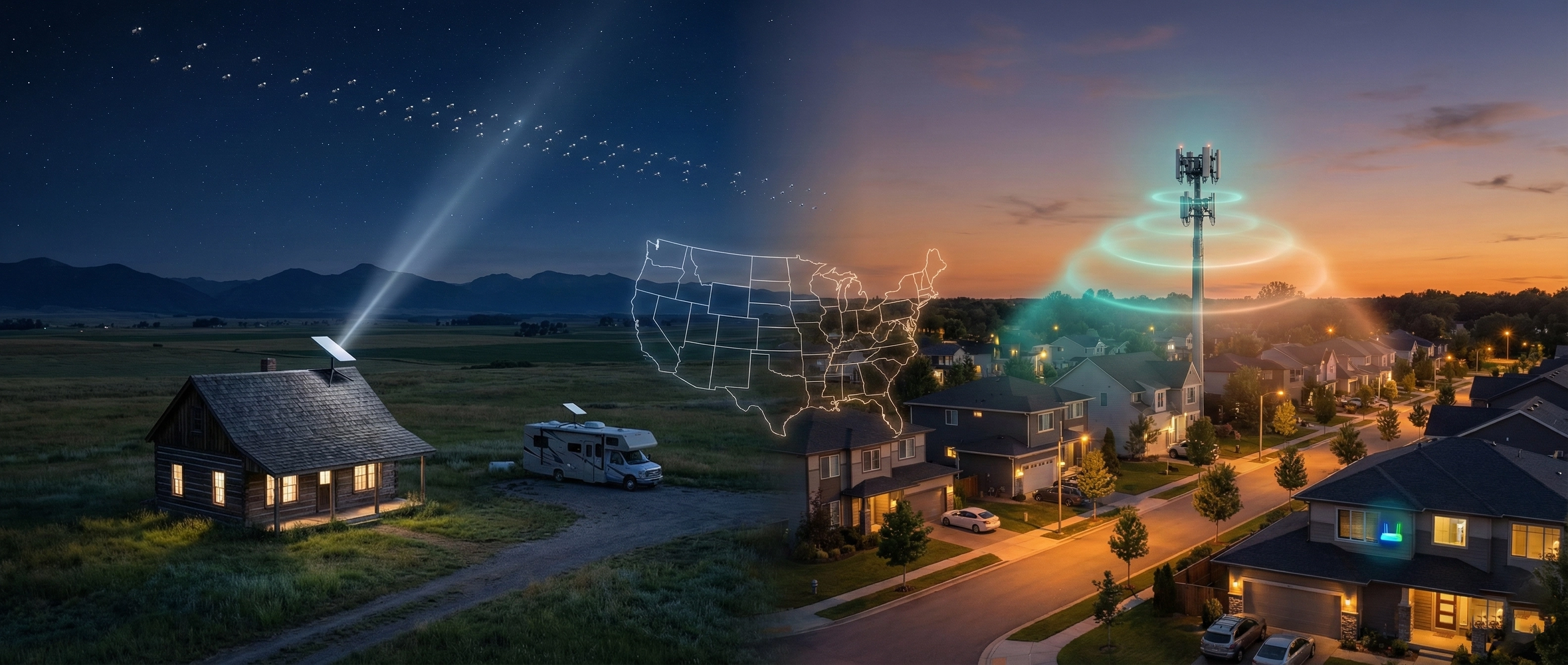
In 2026, the choice between Starlink and 5G Home Internet is no longer about headline speeds or futuristic promises. It is fundamentally a question of geography, population density, and local network conditions. For most U.S. households, the decision has become practical rather than aspirational: use fixed wireless if you live near reliable infrastructure, and satellite if you do not.
Quick Verdict: Best Option by Use Case
Best Overall Value
Lower monthly cost and competitive performance where signal is strong.
Best Rural Coverage
Often the only viable high-speed option beyond wired and cellular reach.
Best "Works Anywhere"
True nationwide availability and portability.
The 2026 Reality Check
Three market shifts define the current landscape. First, Starlink waitlists have largely disappeared across the United States, making service immediately accessible. Second, major 5G providers such as T-Mobile and Verizon now enforce soft data deprioritization thresholds, typically around 1.2 TB during periods of congestion. Finally, while fiber expansion continues, millions of Americans remain underserved, leaving wireless technologies as essential stopgap solutions rather than optional upgrades.
Introduction - Closing America's Connectivity Gap
For decades, the American broadband market was defined by a simple choice: DSL or cable. By 2026, that debate has evolved into something far more consequential - space-based satellite networks versus ground-based cellular fixed wireless. This shift represents the first meaningful competition in years for households long neglected by traditional wired providers.
Despite billions in federal investment, fiber infrastructure currently reaches only an estimated 40-50% of U.S. households. Rural and exurban regions remain dependent on aging copper lines or outdated wireless alternatives. In an era shaped by remote work, 4K streaming, and cloud-based applications, these legacy connections are no longer merely inconvenient—they are functionally inadequate.
Defining the Contenders
How the Technology Actually Works
Understanding the physical delivery methods behind each service clarifies their strengths and limitations.
Starlink: The Space Mesh
Starlink operates thousands of satellites in Low-Earth Orbit, approximately 550 km above the planet. Unlike legacy satellite services that rely on geostationary satellites positioned 22,000 miles away, Starlink's proximity dramatically reduces signal travel time.
- Mechanism: A phased-array user terminal ("Dishy") tracks satellites dynamically.
- Benefit: Significantly lower latency than traditional satellite internet.
- Trade-off: Some variability in performance in exchange for near-universal availability.
- Hardware (2026): Standard Gen 3 dish or portable Starlink Mini for mobile users.
5G Home Internet: The Tower Beam
5G Home Internet delivers broadband by transmitting cellular signals from nearby towers to a fixed gateway inside the home.
- Mechanism: The gateway converts a cellular signal into a Wi-Fi network.
- Sweet Spot: Mid-band (C-Band) spectrum provides the best balance of speed and coverage.
- Trade-off: Excellent performance near towers, but reliability declines with distance or congestion.
Starlink vs 5G: Real-World Performance (2025-2026)
| Metric | Starlink | 5G Home Internet |
|---|---|---|
| Download Speed | 100-200 Mbps (median ~150) | 72-1,000 Mbps (highly variable) |
| Upload Speed | 10-20 Mbps | 10-50 Mbps |
| Latency | 25-40 ms | 20-40 ms |
| Consistency | Moderate | Location-dependent |
Download & Upload Speeds: Starlink provides consistent mid-range speeds, with occasional slowdowns during peak evening hours. 5G speeds vary widely depending on proximity to towers and spectrum availability, ranging from modest to fiber-like performance in ideal conditions.
Latency & Jitter: 5G generally offers lower latency but is susceptible to congestion spikes. Starlink has improved dramatically since early deployments but still experiences occasional jitter that can affect real-time applications.
Reliability & Weather: Starlink requires a clear view of the sky and can be impacted by heavy rain or snow. 5G is largely weather-resistant but vulnerable to congestion and indoor signal degradation.
Cost Breakdown - Pricing & Hidden Expenses
Starlink
- Hardware: ~$599 (Standard), $299-$349 (Mini)
- Monthly: $120 (Standard), $80 (Lite)
- Contracts: None
- Hidden costs: Mounting hardware, cable routing, higher power consumption
5G Home Internet
- Hardware: Free (loaned gateway)
- Monthly: $35-$70 (bundled)
- Contracts: Generally none
- Hidden costs: Optional external antennas in weak-signal areas
Data Caps & Fair-Use Policies
- Starlink: Effectively unlimited on Standard plans; Lite plans are always deprioritized.
- 5G Providers: Soft caps around 1.2 TB; heavy users are deprioritized during congestion.
- Bottom line: For heavy streaming households, data policy matters more than peak speed.
Coverage & Infrastructure Reality
- Urban/Suburban Areas: 5G performs well but coverage maps are optimistic.
- Rural America: Starlink is often the only modern broadband option.
- FCC & BEAD: Fiber rollout remains slow and uneven; wireless remains the interim solution.
Real-World Use Cases
Remote Workers
Best: 5G (strong signal)
Viable: Starlink (occasional micro-drops)
Competitive Gamers
Ranking: Fiber > Cable > Strong 5G > Starlink > Legacy Satellite.
Starlink is playable but not ideal for esports-level performance.
RV / Digital Nomads
Clear Winner: Starlink Mini / Roam.
5G home gateways are geo-restricted and unsuitable for mobility.
Final Decision Framework
- If fiber or cable is available, choose that.
- If not, test 5G Home Internet (lowest cost, strong performance).
- If cellular coverage is weak → Starlink is the definitive solution.
"Starlink is a premium product for Americans without infrastructure options. 5G Home Internet is a cost-effective solution for those within strong coverage zones."
FAQ
Can I install Starlink myself?
Yes, but mounting on a roof may add cost or require professional help.
Is 5G good for gaming?
Yes, generally, provided you have a strong signal. Latency is often lower than satellite.
Is Starlink slower at night?
Often, yes. This is due to peak congestion when everyone is online in the evening.
Is Starlink better than DSL?
Almost always. DSL is legacy technology that struggles to support modern streaming demands.