
Introduction: A Model That No Longer Scales
The "Human-in-the-Loop" architecture emerged as a pragmatic governance layer in early automation. It was designed to solve a specific problem: how to maintain control over systems that were brittle, opaque, or untrusted.
In the context of early 2010s digital transformation, this model was effective. Workflows were asynchronous. Stakes were high. The cost of error exceeded the cost of latency. A human reviewer acting as a final approval gate provided necessary institutional risk control and validation.
However, the operational environment has shifted fundamentally.
Modern algorithmic systems operate at machine speed, executing thousands of micro-decisions per second across distributed networks. They function in real-time markets—such as ad exchanges, high-frequency trading, and automated cybersecurity—where the introduction of a human approval gate creates unacceptable latency. In these environments, the "loop" is no longer a safety feature; it is a critical bottleneck that degrades system performance and compounds operational risk.
This analysis posits a structural transition: we are moving from a paradigm of direct intervention to one of agentic orchestration. This shift is not ideological. It is a necessary response to the scale and velocity of the modern economy.
What "Human-in-the-Loop" Actually Means
To understand why the model is breaking, we must first clarify the technical definition of Human-in-the-Loop (HITL). It is frequently conflated with general oversight, but structurally, it refers to a specific dependency: a workflow where human action is a hard requirement for execution.
The Traditional Architecture
Review Gates: A linear blocking mechanism where a transaction or decision is paused until a human operator grants explicit authorization. This is common in fraud detection and content moderation.
Manual Approvals: A governance requirement where only a human possesses the cryptographic or administrative authority to initiate a sequence.
Validation Layers: A hybrid state where systems flag low-confidence predictions for human adjudication before finalizing a record.
The Historical Logic
This architecture was built on three foundational assumptions of the previous decade:
- Low Trust: Early ML models had high hallucination and error rates; humans served as error-correction layers.
- Asynchronous Tempo: Systems operated on daily or hourly batch cycles, making human latency negligible.
- High Impact of Error: The cost of a single wrong decision (e.g., a loan default) justified the cost of manual review.
These assumptions no longer hold in an agentic economy. As McKinsey's analysis of generative AI's economic potential demonstrates, the ROI gains in agentic workflows depend precisely on removing high-latency human bottlenecks from execution pipelines.
The Breaking Point: When Speed Overtakes Control
The structural failure of HITL occurs when the decision cycle of the system outpaces the cognitive cycle of the human operator.
The Physics of Latency
Consider the operational tempo of modern infrastructure. Programmatic advertising bids occur in under 100 milliseconds. Cybersecurity defense systems must isolate threats in microseconds. Cloud orchestration agents scale resources dynamically based on real-time load.
Inserting a human decision cycle—which spans seconds to minutes—into these loops is effectively impossible. It forces a binary choice: artificially retard the system to human speed (destroying value) or remove the human from the critical path (altering risk).
Humans cannot approve thousands of micro-decisions per second. Attempting to do so does not increase safety; it creates a "shadow loop" where humans approve batches of decisions they cannot possibly comprehend, preserving the appearance of governance while losing the reality of it.
Complexity and Context
Beyond speed, there is the issue of dimensionality. A modern routing algorithm might weigh 500 variables simultaneously. A human operator, limited by working memory, cannot reconstruct the logic of such a decision in real-time. The "review" becomes performative. The operator lacks the necessary context to meaningfully override the system, leading to a state of rubber-stamping.
The Rise of Agentic Systems
The industry is transitioning to agentic systems to resolve this bottleneck. Unlike passive tools or linear automation, agents are characterized by their capacity for autonomous pursuit of objectives within defined constraints.
Defining the Agentic Architecture
An agent is defined by four core capabilities that distinguish it from standard automation:
1. Planning: The ability to decompose a high-level objective into a sequence of executable steps without prescribed scripts.
2. Execution: The authority to interact with external APIs, databases, and environments to effect change.
3. Memory: The maintenance of state and context over time, allowing for iterative improvement and multi-turn workflows.
4. Settlement: The capability to finalize transactions and report outcomes for audit, closing the loop without human intervention.
Operational Divergence
In a traditional workflow, a human connects the output of Tool A to the input of Tool B. In an agentic workflow, the agent acts as the connective tissue. It handles the economic and logical tasks—scheduling, purchasing, debugging, optimizing—continuously.
Agents do not ask "May I execute this step?" They ask "Is this step within my policy constraints?" If the answer is yes, execution is immediate.
Human-in-the-Loop Is Not Dying — It's Moving Up the Stack
It is critical to distinguish between the removal of humans from execution and the removal of humans from systems. The former is happening; the latter is not.
From Operator to Governor
The role of the human is shifting from the transaction layer to the governance layer. We are moving from Human-in-the-Loop to Human-on-the-Loop.
Oversight: Instead of reviewing individual decisions, humans monitor system health metrics and aggregate outcomes.
Governance: Humans define the bounding box—the policy constraints, budget limits, and ethical guidelines—within which the agent operates.
Exception Handling: Humans act as the escalation tier for edge cases that fall outside the agent's confidence threshold.
Related Deep-Dive: Operational Sovereignty in the Agentic Economy
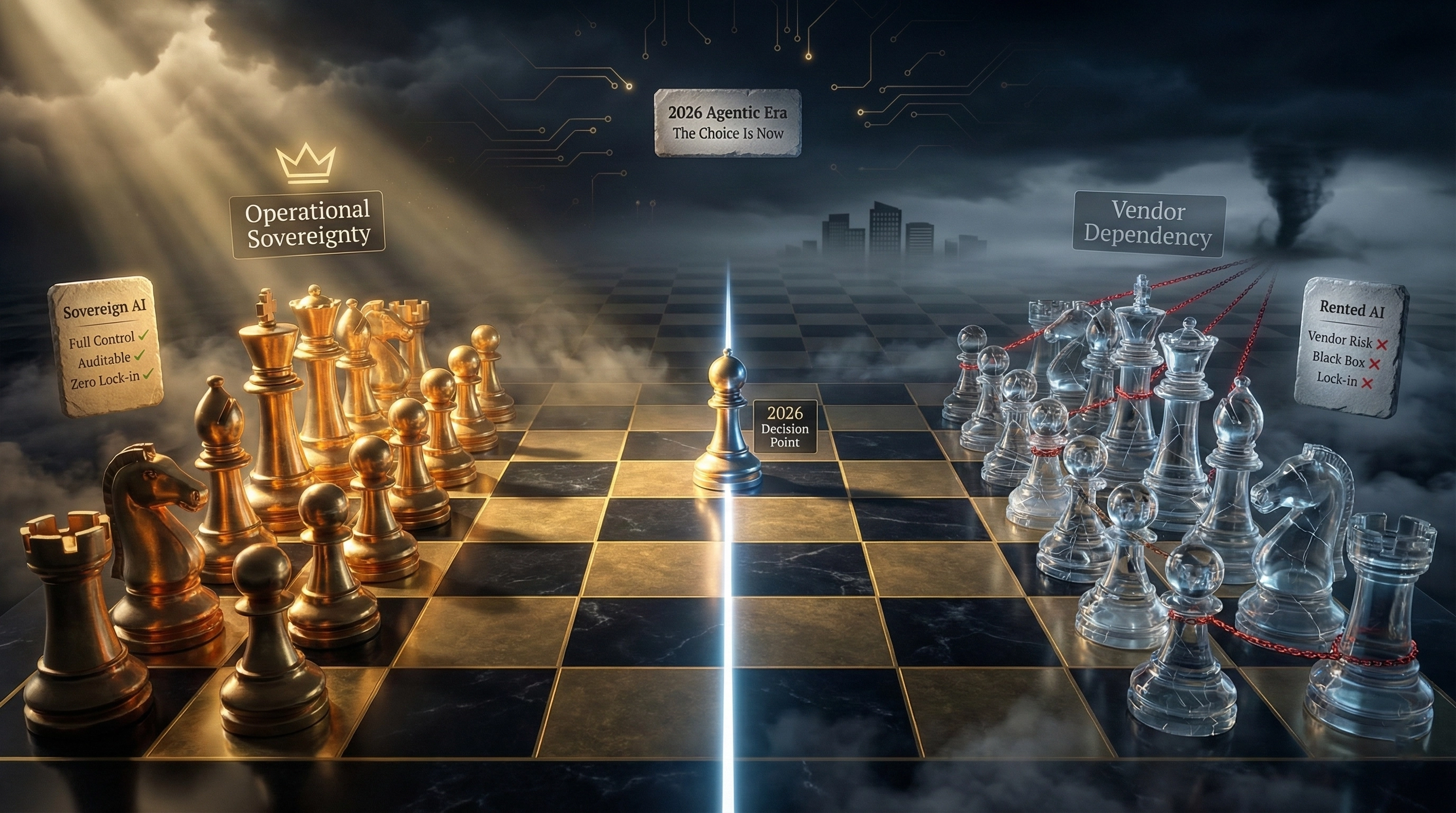
If humans are moving from executing agents to governing them, the strategic question becomes: who controls the policy layer? Our sister analysis examines why organizations that rent their AI infrastructure are building on sand — and what Operational Sovereignty actually requires in 2026.
Read: The Agentic Economy 2026Why This Shift Is Inevitable (Not Optional)
The transition to agentic systems is driven by hard operational metrics, not futurism. Organizations will adopt this model because the unit economics of the alternative are unsustainable.
1. Cost Pressure
Scaling a manual review team is linear: more transactions require more headcount. Scaling an agentic system is logarithmic: once the governance framework is built, volume can increase exponentially with minimal marginal cost.
2. Latency Arbitrage
In competitive markets, latency is a proxy for value. A logistics network that re-routes autonomously in milliseconds will outcompete one waiting for dispatcher approval. The speed differential creates an insurmountable competitive moat.
3. Risk Surface
Counter-intuitively, well-designed agents reduce the risk surface. Human operators are subject to fatigue, bias, and social engineering. An agent operating under cryptographically enforced policy constraints is consistent, auditable, and immune to distraction. The Stanford HAI AI Index Report confirms that structured agent deployments show significantly fewer compliance violations than equivalent human-supervised processes.
Risks of Pretending the Old Model Still Works
Organizations that resist this shift and cling to performative HITL structures face distinct systemic risks.
Approval Fatigue: When humans are flooded with alerts, desensitization occurs. "Click-through" rates on approvals approach 100%, rendering the control mechanism void while retaining the bottleneck.
Shadow Automation: When official workflows are too slow, teams will build unmanaged scripts and "shadow agents" to bypass governance completely. This creates hidden technical debt and security vulnerabilities.
False Sense of Control: The most dangerous system is one where leadership believes a human is in control, but the human is merely reacting to machine prompts they do not understand. This "governance theater" obscures the reality of the system's autonomy.
The New Operating Model: Supervised Autonomy
The viable replacement for Human-in-the-Loop is Supervised Autonomy. This model relies on three pillars to ensure safety without sacrificing speed.
The Three Pillars of Supervised Autonomy
What Leaders Must Do Now
Transitioning to an agentic economy requires a strategic overhaul, not just a software update.
Redesign Workflows: Audit current processes to identify where human review provides genuine value versus where it acts as a latency tax. Systematically remove the latter.
Define Decision Authority: Explicitly codify the "authority matrix" for agents. What budget can they control? What APIs can they access? This must be defined in policy, not ad-hoc.
Separate Execution from Governance: Create distinct teams for "Agent Ops" (monitoring and maintenance) and "Agent Governance" (policy and ethics). Do not conflate the builder with the auditor.
Prepare Teams Psychologically: Move talent away from "checking boxes" toward "designing boxes." The workforce must shift from processing work to defining how work is processed. According to MIT Technology Review, enterprises that proactively restructured human roles around agent governance reported significantly higher ROI from their AI programs within 18 months.
Conclusion: Control Was Never the Point — Accountability Was
The anxiety surrounding the removal of the Human-in-the-Loop stems from a confusion between control and accountability.
Control is the ability to intervene in a specific action. Accountability is the responsibility for the outcome of that action. The agentic economy sacrifices direct micro-control to achieve macro-scale and speed, but it preserves accountability through rigorous governance, audit logs, and clear ownership structures.
We are not surrendering to machines; we are maturing our management of them. By moving humans out of the execution loop and into the design loop, we build systems that are not only faster and more efficient, but ultimately more transparent and robust.
The loop is not broken. It has simply expanded.
Frequently Asked Questions
Does removing the human loop increase systemic risk?
Not necessarily. While it introduces new types of risk, it eliminates the risks associated with human fatigue, inconsistency, and latency. Well-architected agentic systems with "Supervised Autonomy" can actually reduce the net risk surface through enforced policy constraints and perfect audit trails.
What is the difference between an agent and a script?
A script follows a linear, deterministic path (If X, then Y). An agent possesses reasoning capabilities to determine how to achieve a goal (Goal X, Plan Y, Execute Z). Agents can handle ambiguity, recover from errors, and modify their approach dynamically.
How do we handle accountability when an agent fails?
Accountability remains with the human operators who defined the agent's constraints and policies. Just as a manager is responsible for their team, a human governor is responsible for the agents they deploy. The focus shifts from "who clicked the button" to "who set the policy."
Will this eliminate human jobs?
It will eliminate roles focused on rote approval and manual transaction processing. However, it creates demand for higher-leverage roles in system architecture, policy design, compliance auditing, and exception management. The workforce moves "up the stack."
Is this model safe for regulated industries like finance?
Yes, and it is arguably safer. Regulators require auditability and consistency. Agents provide immutable logs of every decision and adhere strictly to coded compliance rules, whereas human manual processes are often opaque and prone to deviation.